
 Girlhood was an important lifecycle stage in the trajectory of eighteenth-century working women. ‘Working girlhood’ is explicitly used in this book to discuss those girls of the middling and lower orders who worked or prepared for work in adulthood, thus these are not only ‘labouring ‘girls, but those in families in town and country who may have worked in their youth, gone to apprenticeship or service, and prepared for the potential of working as adults. Girlhood was multilayered, complex and varies by the period and cultures we are looking at, while historians delineate it differently, depending on their focus. Girls tended to be merged with women in histories from the 1970s as the term girl was avoided since it was often deployed in a demeaning manner, rather than recognising them as having a distinct history of their own. More recently historians have begun to reclaim girls and girlhood as a useful analytical tool, as this book does, while it also specifically addresses the lacunae in histories of eighteenth-century working girls.
This book examines the experience of growing up for those in the middling and lower orders who worked. It draws on a wide range of sources to provide the first comprehensive account of eighteenth-century working girlhood, giving due regard to all areas of Britain: Scotland, Irdland, Wales and England. It examines the lifecycle stage of growing up for the middling and lower classes as they worked and prepared for a life of work. Written for readers interested in the transformative years before adulthood, the book argues that history has tended to slide over girls in its focus on women’s history, often forgetting that girls probably made up almost half of all females. Examining the role of home, schools and apprenticeship in girls’ upbringing, it also consideres how mobility shaped their trajectories. Furthermore it examines socialibility, love, sex and the ‘misfortunes’ they might encounter. An underpinning message is the active role that girls played in shaping their own destinies using whatever tools at their disposal.
The book begins by defining girlhood and lifecycle, ages and stages of girlhood, concepts of youth and girlhood, law and custom, gender, ideology, family, love and care, education, literacy and oral traditions. The following chapter deals with schooling for girls, including gender and opportunity, teaching and learning, the effect of duration of schooling as well as the impact of geography and demongrapy on girls’ access to schools. The book then turns to preparation for work including apprenticeship, both parish and private, with a case study on mantuamakers and milliners who drew from mainly the lower middling orders. The book also analyses mobility within aprenticeship especially, fleshing out the extent to which girls stayed close to home and family—when they had one—and when they went further away. This is followed by making a living, looking at service, both rural and domestic, at hired workers, work relationships and the characteristics of their work, with posiitons often peripatetic and of short duration. Earning and the uses of money figures next looking across a range of employments, balancing budgets, and making shift. The book also recognises that credit played a role in girls use of money as both borrowers and lenders. As life was not all work and no play, the book then takes up social Life, associations and leisure, examining time and places for these activities and exploring solidarities and comraderies. This leads logically to discussions of love and courtship, reflecting on law, custom, practicalities and romance and passion. Clearly not all paths run smoothly and the next two chapters examine ‘when things go wrong’ and how girls dealt with misfortune looking at, poverty, illegitimacy, sexual violence, abandonment, infanticide, prostitution and crimilal behaviour. The book concludes with thoughts on the end of girlhood and a discussion of female agency and the extent to which girls had a hand in shaping their girlhood. Throughout the book there is an awareness of the problems of knowing and the nature of sometimes elusive sources. Similarly it attempts to illustrate the variety of routes and possibilities girls experienced.
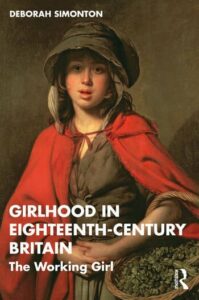
Girlhood in Eighteenth-Century Britain: The Working Girl by Deborah Simonton has just been published by Routledge.