
Until reading this blog, many of you have probably never heard of the Bradford Reform Jewish community. They are Britain’s third oldest Reform Jewish community and are still active today. Bradford’s earliest Jewish settlers arrived between the 1830s and 1870s. They were predominantly German woollen merchants because Bradford was the centre of the wool trade. My research has shown that the community included people born in Austria, France, Italy, Poland, and Russia. Bradford’s German Jewish immigrants were among those who became very well assimilated through their business connections, involvement in local politics, and membership of non-Jewish organisations. In this article, I will define assimilation as the process by which someone becomes less visibly identifiable by adopting the culture and values of their place of settlement. Compared to larger Jewish communities, such as Leeds, Bradford had very few communal institutions. It was not until 1875 that the community purchased a quarter of an acre of land for a burial ground, located within Scholemoor, a non-Jewish cemetery.
This article is based on my findings from my research trip to Berlin’s Jewish and Christian cemeteries in September 2025, kindly funded by the Social History Society. I photographed the headstones in two cemeteries, Schönhauser Allee and Weißensee, and two non-Jewish cemeteries, Dorotheenstadt and Zentralfriedhof. I then examined the continuities and changes in the types of identities expressed through funerary art, architecture, and epigraphy between the 1870s and the 1930s by analysing the headstones photographed during my trip. My study also explored how Christian influences in Berlin’s non-Jewish cemeteries shaped the designs and art found in Schönhauser Allee and Weißensee. This was then followed by a comparative analysis of the architecture, symbolism and inscriptions in Bradford and Berlin’s Jewish cemeteries. I visited Germany because most of those interred in the Bradford Reform Jewish Cemetery from the site’s opening in 1877 until the 1930s were German Jewish immigrants.
The data I collected during the trip will form part of my PhD thesis, which investigates how Bradford’s Reform Jewry expressed their religious, national, and local identities through their headstones and burial practices between 1877 and 1935. My project also explores changes in the community’s burial practices and attitudes towards commemoration.
This blog explores one headstone in the Bradford Reform Jewish Cemetery, using it as a lens to examine how German funerary traditions were reflected in the headstones of some of the first-generation German Jewish immigrants buried in Bradford.
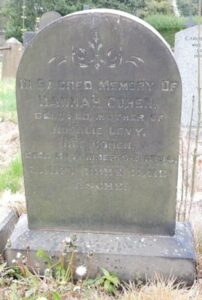
Hannah Cohen was a first-generation German immigrant who, in the mid-nineteenth century, moved from Germany to Scotland with her daughter, Rosalie. It is unclear when Hannah arrived in Yorkshire, but the 1901 Census returns indicate that Rosalie moved from Scotland to Leeds and then to Bradford between 1884 and 1886. Hannah was admitted to Menston Asylum in West Yorkshire on the 21st May 1889, where she died on the 5th November 1894.
After her mother’s death, Rosalie purchased a small round-topped headstone with a small decorative motif above the inscription. The inscription on Hannah’s headstone reflects broader changes in Jewish cemeteries in Britain, as it is written almost entirely in English rather than the traditional language, Hebrew. However, the final line is written in German and says, ‘Sanft ruhe ihre asche’, which translates as, ‘may her ashes gently repose’. This phrase does not mean that Hannah was cremated; it was commonly used by surviving relatives in German headstone inscriptions and obituaries from the early nineteenth century to express their desire that the deceased be at peace.
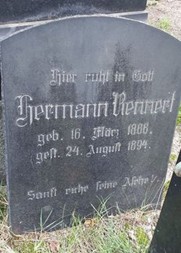
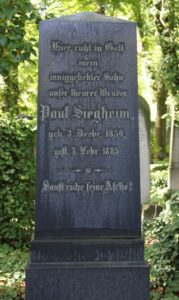
I found many examples of the phrase written on Hannah’s headstone and other variations in Schönhauser Allee, Weißensee and Dorotheenstadt between 1877 and 1935. Paul Siegheim’s headstone in Weißensee Cemetery displays the phrase, ‘sanft ruhe seine asches’, which means, ‘may his ashes rest in peace’. Hermann Rennert’s headstone at Dorotheenstadt Cemetery, dating from 1894, also features the same phrase. The German phrases on the gravestones are an example of the ongoing dialogue between Jewish and Christian funerary traditions during the nineteenth and twentieth centuries. Jewish families chose which non-Jewish traditions to incorporate into their practices. In Europe, the influence of Christian cemeteries on those of their Jewish neighbours’ dates back to the nineteenth century, when Jewish people were granted full Prussian citizenship in 1815, and therefore gained full equality with Germany’s non-Jewish population. Many German Jewish people assimilated well into non-Jewish society, and a substantial number experienced social mobility.
The nineteenth century also marked the start of an ongoing dialogue between Britain’s Jewish and non-Jewish cemeteries as many Jewish people became increasingly assimilated. Jewish cemeteries began to follow the fashions of the day, offered by non-Jewish stonemasons and architects.
Hannah’s headstone is one of three in this cemetery inscribed in German, all of which belonged to first-generation German Jewish immigrants. The German inscriptions on these gravestones demonstrate how German funerary traditions crossed borders with immigrants. In Hannah’s case, they also illustrate how these traditions were also imposed on the deceased by their relatives because her gravestone was purchased by her daughter, Rosalie Levy, who was also a first-generation German immigrant. The inscription on Hannah’s tombstone is just one example of how families tried to negotiate their national identity and maintain connections to their country of origin in death, while also showing that they had become assimilated by including English. The absence of German on the gravestones of most first-generation immigrants and of any second-generation immigrants also highlights the fragility of these traditions.
Gravestones allow us to explore the stories of migrants and how they negotiated different aspects of their identity. What is present, and what is missing from the deceased’s headstone, reveals how they and their families wanted the world to remember them. Like other migrant groups, Bradford’s German Jewry’s migration was not a one-way process in which families abandoned their cultural practices and traditions from their country of origin in favour of those of their place of settlement. There remained an ongoing dialogue between those who settled in Bradford and their country of origin as they negotiated their German identity. The absence of German traditions on the headstones of most first-generation and any second-generation Jewish immigrants highlights how identity constantly evolved.
Sophia Lambert gratefully acknowledges the support of the Social History Society with this project.
About the author:
Sophia Lambert is a PhD candidate in History at the University of Leeds, researching identity, burial practices, and commemoration in the Bradford Reform Jewish community in the late-nineteenth and early twentieth centuries. She completed her BA in History at Leeds Beckett University in 2021. In 2022, Sophia studied for an MA in Social and Cultural History at the University of Leeds. She is the founder of the Instagram account @Leeds_hidden_heritage, which explores the rich and diverse histories of Leeds. Sophia’s research interests include Jewish cemeteries, Yorkshire’s Jewish communities, Leeds history, and housing in nineteenth and twentieth-century Britain.
Sophia Lambert, University of Leeds
Thank you for sharing this piece. It is a thoughtful and beautifully grounded study, and I found the comparative framing between Bradford and Berlin particularly effective. The sensitivity to language, epigraphy, and the negotiation of identity through headstones really comes through, and it resonates strongly with my own work on provincial Jewish communities, albeit in an earlier period.
One question your post prompted, very much in a spirit of shared curiosity rather than critique, concerns the process behind the stones themselves. In my own research I have been struck by how difficult it is to trace the practical and institutional mechanics of burial: who the masons were, how inscriptions were agreed or checked, and what degree of communal oversight existed, especially in smaller or Reform contexts. I wondered whether you had encountered any archival traces of this in Bradford, or whether, as I have found elsewhere, this aspect of local burial practice remains largely undocumented.
In any case, this is a really valuable contribution, and it is a pleasure to see provincial Jewish cemeteries treated with such care and seriousness.
Brian
Thank you for your kind comments, Brian. It is great to hear that you found this article so thought-provoking.
It is always encouraging to hear of someone else who is also researching provincial Jewish communities, as there seem to be very few of us!
I am afraid I am also struggling to answer your questions about the stonemasons and the mechanics of burial, as this is something I have considered for my thesis. It appears that the masons left very few records. Of course, it is also possible that this material has not survived. I have yet to come across any records in Bradford about who checked the inscriptions.
I will reach out if I come across any useful information. In the meantime, good luck with your research.